
UX Research Case Study
Quill Catalog User Research
Challenging a long-held business assumption through customer interviews, usability studies, and behavioral analysis, ultimately revealing that customers used Quill’s catalog and website very differently than the organization believed.
Project Highlights
Overview
During my time at Quill Corporation, one particular belief was treated almost as fact throughout the organization.
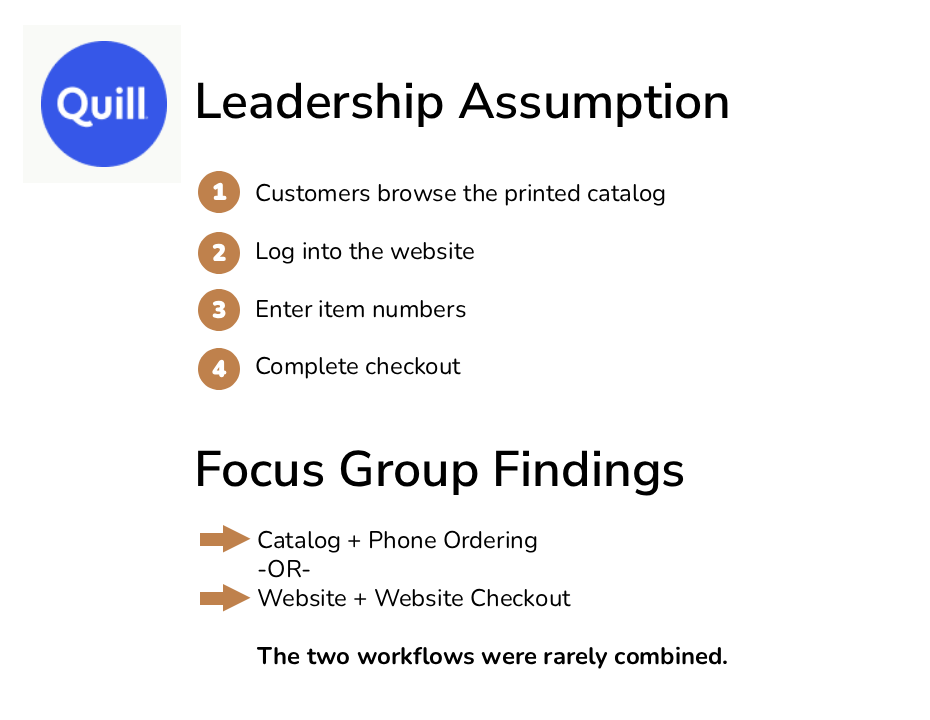
The story went something like this: customers received the printed catalog, browsed products, then sat down at Quill.com and entered item numbers directly into the website.
The belief was so widely accepted that the web team invested in creating a feature called Catalog Quick Entry, allowing users to enter catalog item numbers directly into the site for rapid ordering.
On paper, it sounded perfectly reasonable. There was only one problem: nobody had actually verified whether customers behaved that way.
The Assumption
The prevailing belief crossed departmental boundaries. Marketing believed it. Merchandising believed it. Leadership believed it. The web team believed it.
The assumption had become accepted wisdom simply because it had been repeated often enough.
The research created an opportunity to compare that internal story against actual customer behavior.
The Research
Through customer interviews and usability studies, we began asking a simple question:
How do you actually place your orders?
We expected to hear stories about customers flipping through catalogs while entering product numbers into the website.
Instead, we discovered something completely different.
What We Learned
Customers generally fell into one of two groups.
Catalog Customers
- Preferred printed catalogs
- Typically ordered by phone
- Relied on traditional purchasing habits
- Rarely transitioned into the online experience
Website Customers
- Preferred online browsing
- Used search and category navigation
- Added items directly to their carts
- Rarely referenced the printed catalog
What surprised everyone was the lack of overlap between the two groups. The hybrid behavior the organization had optimized around was largely nonexistent.
Why This Mattered
The findings were significant because they challenged a long-standing narrative within the company.
Resources had been invested in solving a problem customers were not actually experiencing. More importantly, the study reminded stakeholders that intuition, tradition, and assumptions can only take a business so far.
Sometimes the truth lives entirely outside the conference room.
My Contribution
As Internet Design Manager, I participated in usability studies, customer interviews, and behavioral analysis efforts aimed at understanding how customers truly interacted with Quill’s products and services.
- Conducted customer interviews
- Participated in usability testing efforts
- Documented behavioral patterns
- Compared assumptions against observed behaviors
- Presented findings to internal stakeholders
- Helped advocate for evidence-based decision making
Outcome
The research gave the organization a clearer understanding of customer behavior and highlighted the importance of validating assumptions before investing in features or functionality.
While the Catalog Quick Entry feature itself was not harmful, the study demonstrated that customer behavior was much more segmented than previously understood.
The findings encouraged deeper consideration of how different customer groups preferred to engage with Quill.
Reflection
This project remains one of the most important lessons of my career.
Not because of the feature. Not because of the technology. But because it demonstrated how easily organizations can become attached to stories that feel true without ever verifying whether they actually are.
Since then, I have carried a simple principle into every design, research, and product effort:
Listen to the user first. Validate assumptions second. Design solutions third.
That sequence continues to serve both users and businesses well.
Supporting Artifact
A research summary visual representing the catalog-to-web ordering assumption and the customer behavior uncovered through the study.
Interested in working together?
Whether you’re validating customer assumptions, improving a digital workflow, or turning research into stronger product decisions, I’d love to hear about it.
Get in Touch