
UX Research Case Study
Quill Catalog Ordering Research Study
A customer research study that challenged a long-held business assumption about how Quill customers used printed catalogs and the website to place orders.
Project Highlights
Overview
In 2004, Quill wanted to better understand how customers used its printed catalog, website, landing pages, and HTML email campaigns.
One long-held belief inside the organization was that customers commonly used the printed catalog and website together as part of a single ordering workflow.
The research effort was designed to confirm or challenge that belief and gather feedback on broader digital initiatives.
The Business Assumption
The story inside the business was simple and widely accepted.
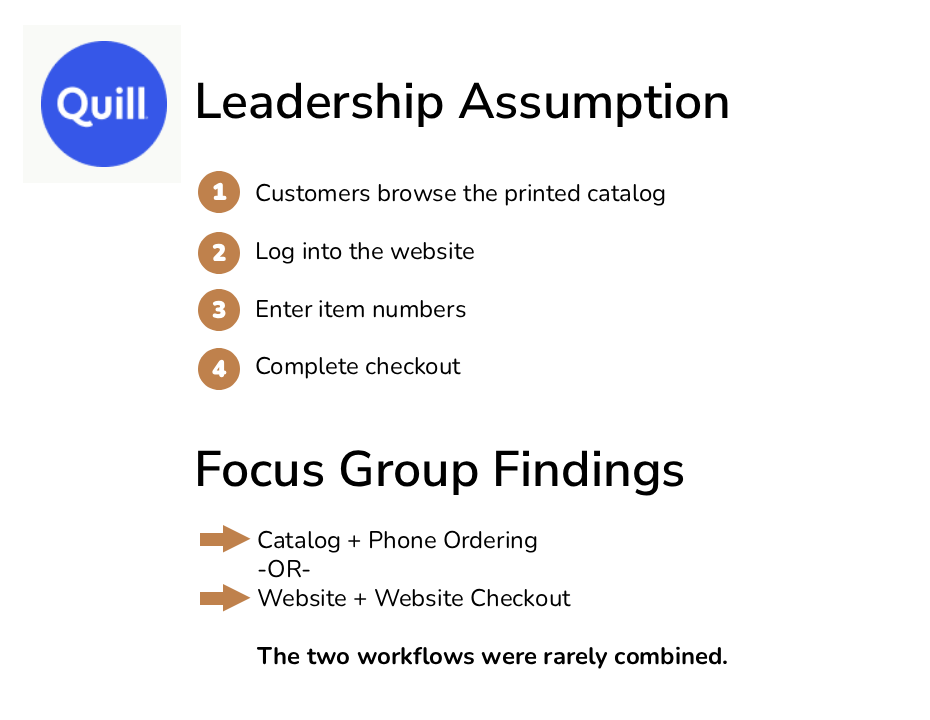
A Quill catalog would arrive in the mail. Customers would flip through it, highlight desired products, dog-ear pages, and identify item numbers. Then they would log into their Quill account online, enter those item numbers into the website, update their cart, complete the order, and log out.
It was a plausible story. It was also the reason features such as Catalog Quick Order seemed useful.
But plausibility is not proof.
Research Questions
The research focused on several practical questions:
- How do customers actually shop?
- Are printed catalogs still effective?
- Do customers combine catalog browsing with online ordering?
- Do customers review and order from promotional emails?
- How are landing pages and HTML email campaigns being received?
Method
The research was conducted through on-site customer interviews and observation.
Our team observed sessions from behind two-way mirrors while customers discussed their shopping habits and ordering behaviors.
I also reviewed analytics to compare stated behavior against available usage patterns.
What We Discovered
The core assumption was wrong.
Customers were not typically mixing catalog browsing with online item-number entry.
Instead, behavior generally fell into two separate patterns:
- Customers used the printed catalog and ordered by phone.
- Customers searched or browsed online and ordered through the website.
The hybrid workflow leadership believed was common did not appear to be happening at the volume or frequency expected.
Why It Mattered
The finding mattered because it challenged a business story that had influenced product thinking.
If customers were not using catalog item numbers online as expected, then the website did not need to over-prioritize that workflow.
It also suggested that catalog customers and web customers were behaving as more distinct groups than leadership had assumed.
What Happened Next
The research gave leadership new insight into real customer behavior and challenged assumptions about cross-channel ordering.
Better-informed decisions followed, and the Catalog Quick Order feature appears to have been phased out over time as its expected value did not match actual behavior.
Outcome
The study helped the organization better understand the difference between assumed behavior and observed behavior.
It provided evidence that customers were using catalog and web channels differently than expected and helped leadership make more informed decisions about the online ordering experience.
Reflection
This project remains important to me because it proved that research is most valuable when it disproves what everyone believes to be true.
Organizations often design around internal stories about customer behavior. Research replaces those stories with evidence.
Validate the behavior before designing around the assumption.
Supporting Artifact
A visual summary of the customer ordering behavior research and the assumption that was tested during the study.
Interested in working together?
Whether you’re validating customer assumptions, improving an eCommerce workflow, or turning research into better product and business decisions, I’d love to hear about it.
Get in Touch